


Game Check Wild Turkey Harvest Reporting
All turkeys harvested during the spring turkey season must be reported to the Mississippi Department of Wildlife, Fisheries, and Parks Game Check system by 10 p.m. on the day on which the harvest occurs. As part of the Game Check process, all turkey hunters are required to carry a current harvest reporting record while spring turkey hunting. The reporting record may be either (a) the MDWFP reporting application on a smartphone with the hunter's profile and subsequent harvest history; (b) a paper copy of the MDWFP harvest reporting record; or (c) provided by the hunter. Before moving a turkey from the harvest location, hunters must, at minimum, document their name and date on the harvest reporting record. There are three ways to complete the Game Check process and receive a confirmation number. Hunters can either (a) log the harvest into the MDWFP reporting application on a smartphone; (b) enter the harvest via the Game Check website at www.mdwfp.com/gamecheck, or (c) call the Game Check reporting phone line at 1-800-BE-SMART.
General Hunting Regulations & Requirements
Landowner permission is required to hunt, fish or trap on the lands of another. Department of Wildlife, Fisheries, and Parks Wildlife Management Areas are subject to special seasons and regulations which may vary from statewide seasons and regulations. Contact the MDWFP or area personnel for information about these areas.
License Requirements
- Resident - Each resident of the State of Mississippi ages sixteen (16) to sixty-four (64), must obtain a hunting license, except while hunting on lands titled in his name. Any person sixty-five (65) or older, or any person otherwise exempted from obtaining a hunting license, must have documentation with him/her at all times while hunting as described in #3 (Exemptions). [MS. Code 49-7-5]
- Non-Resident - All non-resident hunters, except minors under the age of sixteen (16), are required to obtain a hunting license while hunting in the State of Mississippi.
Hunter Education Course
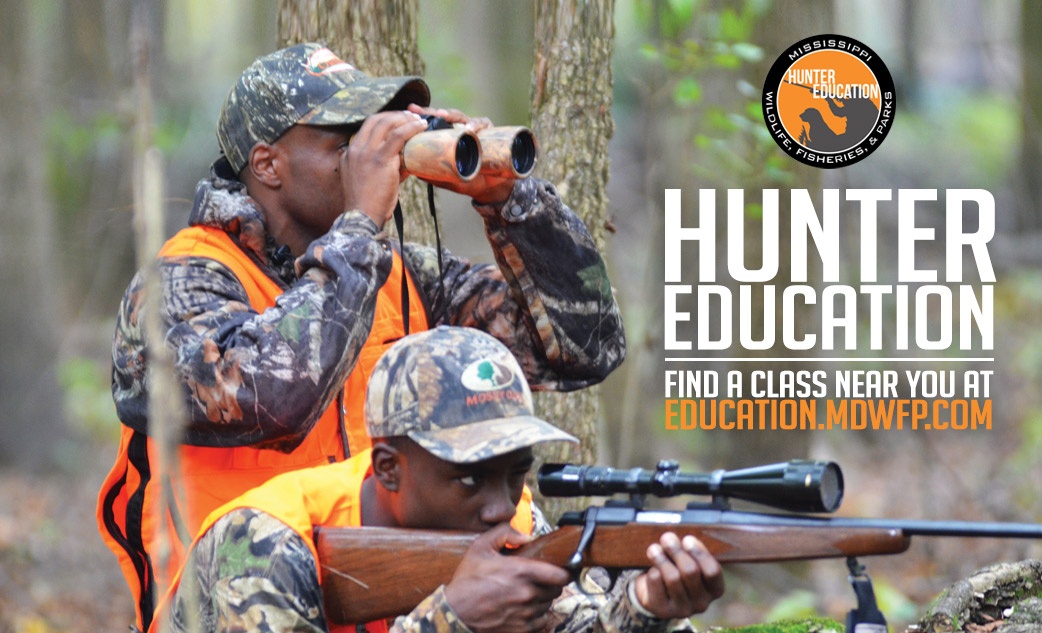
All persons born on or after January 1, 1972, must satisfactorily complete a hunter education course approved by the Department of Wildlife, Fisheries, and Parks before purchasing a Mississippi hunting license. If it is determined that the holder was not entitled to issuance or obtained the license or hunter education certificate by fraudulent means, the license will be revoked or canceled. It is unlawful to issue a hunting license to any person in this age group without proof of completion of the hunter education course. [MS. Code 49-7-20]
License Exemptions
Residents who are visually impaired, paraplegic, a multiple-amputee, adjudged totally disabled by the Social Security Administration or totally service-connected disabled by the Veterans Administration are not required to purchase a HUNTING OR FISHING LICENSE. [MS. Code 49-7-5 and 49-7-9] Residents exempt based on this criteria are required to have proof of their age, residency, disability status or other physical impairment in their possession while engaged in hunting and fishing activities. All exempt licenses previously issued for DISABILITIES are null and void.
Unlawful Purchase of License
Any person who obtains a license under an assumed name or makes a materially false statement to obtain a license is guilty of a felony and shall be subject to a fine of two thousand dollars ($2,000) or may be imprisoned for a term of one (1) year or both.
Shooting Hours
Legal shooting hours for resident game are one-half (1/2) hour before sunrise to one-half (1/2) hour after sunset. Legal shooting hours for migratory birds are one-half (1/2) hour before sunrise to sunset.
Legal Game
Raccoon, fox, opossum, beaver, and bobcats may be legally hunted at night, with or without the use of a light, and with dogs, except during the spring turkey season. For legal deer see "Hunting Deer" for legal sizes and bag limits.
Weapons & Loads
Legal weapons for hunting from one-half (1/2) hour after sunset to one-half (1/2) hour before sunrise are restricted to handguns or rifles using no larger than .22 standard rim-fire cartridges (no 22 magnums) and shotguns with shot no larger than No. 6. When hunting migratory birds, a shotgun must be "plugged" so that it can hold no more than three (3) shells at one loading. The hunting of turkeys during the spring gobbler season shall be restricted to shotguns only and with no shot larger than number two, compound, re-curve, Cross bow, and long bows. However, any quadriplegic may hunt turkey with a rifle.
Primitive Weapons
Weapons legal for use during the Primitive Weapons season are all archery equipment and primitive firearms. "Primitive firearms," for the purpose of hunting deer, are defined as single or double-barreled muzzleloading rifles of at least .38 caliber; OR single shot, breech loading, metallic cartridge rifles (.35 caliber or larger) and replicas, reproductions, or reproductions of those type rifles with an exposed hammer; OR single or double-barreled muzzleloading shotguns, with single ball or slug. All muzzleloading primitive firearms must use black powder or a black powder substitute with percussion caps, #209 shotgun primers, or flintlock ignition. "Blackpowder substitute" is defined as a substance designed, manufactured, and specifically intended to be used as a propellant in muzzleloading or other black powder firearms, excluding modern smokeless powder. Metallic cartridges may be loaded with either black powder or modern smokeless powder (cartridges purchased at sporting goods stores). Telescopic sights are allowed while hunting with any primitive firearm during the primitive weapon seasons. During any open season on deer with primitive weapons after November 30, a person may use any legal weapon of choice on private lands only, if the person is the title owner of the land, the lessee of the hunting rights on the land, a member of a hunting club leasing the hunting rights on the land, or a guest of a person specified above. If the person is required to have a hunting license, the person must have a primitive weapon license, Sportsman's License, or a Lifetime Sportsman's License.
Decoys & Bait
It is illegal to hunt or trap any wild animal or wild bird with the aid of bait. Liquid scents may be used. Electrically operated calling or sound-reproducing devices may be used for hunting nuisance animals and crow only.
Hunting Dogs
Hunting turkey with dogs is prohibited. During the spring turkey season, it is illegal to run dogs in areas where the turkey season is open, except in permitted enclosures. Dogs are not allowed for hunting deer during archery season, primitive weapons season, or still hunting season. Application for dog field trials must be made to the Department of Wildlife, Fisheries, and Parks at least 14 days before the opening of the trial.
Hunting from Roads, Vehicles, & Boats
It shall be unlawful for any person to hunt, if such person is in the possession of a firearm that is not unloaded, on any street, public road, public highway, levee, or any railroad which is maintained by any railroad corporation, city, county, levee board, state or federal entity or in the right-of-way of any such street, road, highway, levee or railroad. "Unloaded" means that a cartridge or shell is not positioned in the barrel or magazine of the firearm or in a clip, magazine, or retainer attached to the firearm. An unloaded muzzleloading caplock firearm is one with the cap removed. An unloaded muzzleloading flintlock firearm is one with no powder in the flashpan. It is illegal to hunt or kill any game animal, furbearing animal or game bird from any motorized vehicle or boat. However, squirrels and game birds may be hunted from a boat if the motor is off and the progress of the boat has ceased.
Hunting Deer
- Delta Zone: Areas west of I-55 and north of I-20 plus areas south of I-20 and west of U.S. Highway 61.
- Northeast Zone: Areas east of I-55 and north of U.S. Highway 82.
- East Central Zone: Areas east of I-55, east of U.S. Highway 49, south of U.S. Highway 82, and north of U.S. Highway 84.
- Southwest Zone: Areas east of U.S. Highway 61, south of I-20, west of U.S. Highway 49, and west of MS Highway 35.
- Southeast Zone: Areas south of U.S. Highway 84 and east of MS Highway 35.
Bag Limits
Antlered Buck Deer:
- The bag limit on antlered buck deer is one (1) buck per day, not to exceed three (3) per annual season. One of those three may be any antlered deer on private land and Holly Springs National Forest. Legal bucks must meet the antler criteria within the appropriate deer management zone. For youth hunters fifteen (15) years of age and younger, hunting on private land and authorized state and federal lands, all of the three (3) buck bag limit may be any antlered deer.
Antlerless Deer:
- Private lands: The bag limit on Northeast, Delta, East Central, and Southwest Zones antlerless deer is five (5) per annual season. The bag limit on Southeast Zone antlerless deer is one (1) per day, two (2) per annual season.
- U.S. Forest Service National Forests: The bag limit is one (1) per day, not to exceed five (5) per annual season except in the Southeast Zone which is two (2) per annual season/one (1) per day.
Spotted Fawns are not to be killed or molested at any time.
All deer hunters must wear, in full view, a minimum of 500 square inches of solid unbroken continuous daylight fluorescent hunter orange material during open gun seasons on deer. Depredation permits for the killing of deer when they are destroying crops are issued only by a DWFP officer after a supervised approved field inspection. If a person is convicted of killing any deer out of season, he may be fined not less than $100, and his license may be revoked for a year by the Commission on Wildlife, Fisheries, and Parks. Anyone who hunts or kills any deer with any lighting device is subject to a maximum fine of $5,000, five days in jail, and the loss of hunting, fishing, and trapping privileges for three years. This does not apply to a deer killed in an accident with a motor vehicle. Any equipment used to hunt or kill deer at night with a lighting device that is subject to seizure is considered contraband property and will be seized by the enforcement officer. This equipment is subject to forfeiture and may become property of the State of Mississippi.
Transporting Game
No person shall take in any one calendar day, no more than the daily creel or bag limit or bag limit of fish. No person at any time, by any means, or in any manner, transport more than seven (7) daily creel or bag limits of fish for each qualified angler present in the vehicle. A single angler may only transport his or her own limit(s) of fish, not to exceed seven (7) daily limits.
Selling of Animals Native to Mississippi
Person cannot buy or sell or offer for sale, or exchange for merchandise or other consideration, any game animal, game bird or game fish (regardless of whether it was taken in or out of Mississippi), except as follows: the skins and sinew of legally taken deer may be bought or sold at any time and the carcasses of raccoons and muskrats may be sold for food during the open trapping season, and raccoon carcasses may be sold during the open gun season on raccoons. It is also illegal to buy or sell any non-game wildlife native to the State of Mississippi.
Protected Wildlife
All birds of prey (eagles, hawks, osprey, owls, kites and vultures) and other nongame birds are protected and may not be hunted, molested, bought, or sold. English sparrows, starlings, blackbirds, and crows may be taken according to regulations. The following endangered species are also protected: black bear, Florida panther, gray bat, Indiana bat, all sea turtles, gopher tortoise, sawback turtles (black-knobbed, ringed, yellow-blotched), black pine snake, eastern indigo snake, rainbow snake, and the southern hognose snake.
Hunter Orange
When hunting deer during any firearms season for deer, a hunter must wear in full view at least five hundred (500) square inches of solid unbroken fluorescent orange unless hunting in a stand at least twelve feet above ground or in a fully enclosed deer stand or blind. However, hunters must wear hunter orange while traveling to and from their stand. Hunters are also encouraged to carry a light while walking into the woods before daylight or leaving after dark.

