Turkey

Every hunter has a unique motivation that draws them afield, but one thing all hunters share is a profound bond with wild things and wild places.

Hunting is not just a hobby, it is a ritual handed down through the ages. The tie between hunters and the animals they pursue is intimate and sacred, and though the hunt’s end might be one-sided, hunters nonetheless feel obligated to give back more than they take. This is why hunters have always been the cornerstone of conservation in North America. Through their hard work, license dollars, and self-restraint, hunters help ensure the natural resources they treasure will be handed down in better shape to future generations.

Unfortunately, not all share this mindset. For some, the rules and traditions dedicated to sustaining our wildlife are just barriers to their own outsized egos.

On April 21, 2019, one of the largest wild turkey poaching cases in U.S. history began with the simultaneous execution of search warrants by three teams of MDWFP Conservation Officers at separate residences in Lincoln and Copiah counties. The officers had been tipped off by a concerned hunter who shared specific details about individuals who egregiously exploited the turkey bag limit and brazenly bragged about it publicly. In all, more than 100 pieces of evidence were collected that day. Three south region officers, Master Sgt. Sheila Smith, Master Sgt. Randy Cooley, and Cpl. Jake Guess were given the painstaking task of sifting through the sizable pile of evidence. The case, known internally as Operation Longbeard, eventually uncovered what Col. Steve Adcock, the then-Chief of MDWFP Law Enforcement, called “the most blatant disregard for Mississippi’s conservation laws I have seen in my 33 years of service.”

As officers began digging through the evidence confiscated from the seizures, an appalling picture emerged. An initial review suggested this small group of poachers had illegally killed almost 100 gobblers in southwestern Mississippi during the spring of 2019. In addition, they used a network of co-conspirators, including their spouses and children, as drivers in an elaborate trespassing scheme onto private properties across Claiborne, Copiah, Franklin, Jefferson, and Lincoln counties. Furthermore, their crimes were not limited to Mississippi, as evidence showed some of the poachers had taken their greed on the road. Four members of the group illegally killed 25 turkeys across Kansas and Nebraska without hunting licenses. Under the Lacey Act, interstate travel with illegally obtained wildlife is a federal offense. By bringing the illegally taken spurs and beards back to Mississippi, the poachers moved portions of the case under the jurisdiction of the U.S. Fish and Wildlife Service. This brought added support from federal special agents and Conservation Officers in the respective Midwestern states.

It is difficult to measure the full impact poaching has on wildlife resources. While well-intentioned rules protect and steward game populations, there will always be those who purposely ignore them for their own selfish gain. This tendency is disturbingly common amongst turkey hunters. Every year, MDWFP asks volunteers who participate in its Spring Gobbler Hunting Survey about the amount of illegal activity they encounter during the spring season. Typically, about one hunter in five reports having firsthand knowledge of game law violations involving turkeys. Exploitation of the bag limit is most commonly cited, accounting for just under half of all known abuses. Baiting is the second most common, while trespassing is third. The combination accounts for 9 of 10 known violations reported by survey participants. While game violations might sound trivial, consider that only about 140 gobblers are legally harvested in the average Mississippi county each spring (based on MDWFP Game Check numbers). The sum total killed by the handful of poachers investigated in Operation Longbeard was equivalent to 70% of the average county’s legal harvest, and these were just the birds Conservation Officers had in evidence. Few outlaws are this extreme, but if, on average, one in five turkey hunters annually encounters poaching from someone in their circle of acquaintances, then the damage to the turkey population would be overwhelming. This should be sobering given current concerns about the wellbeing of Southeast turkey populations and recent calls to reduce legal hunting opportunities to offer additional protection.
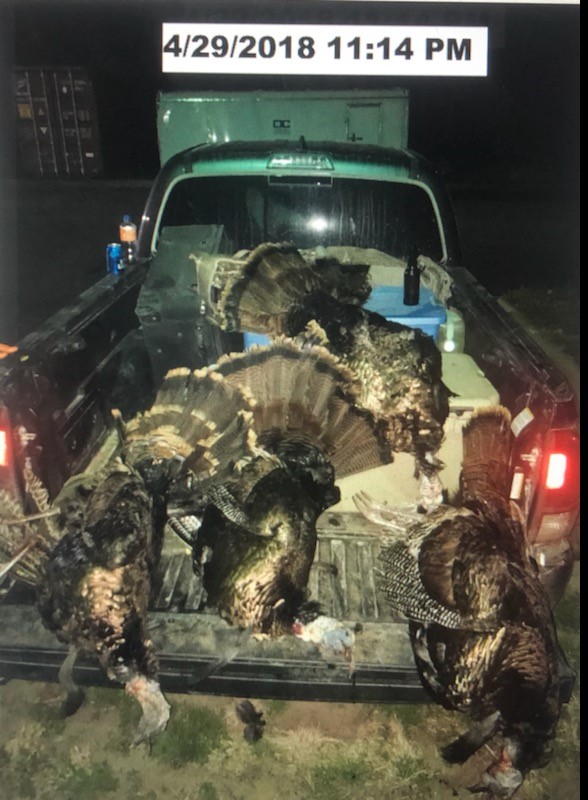
Operation Longbeard was considered unrivaled in scale. No wild turkey case in modern U.S. history was so sweeping, yielding so many convictions. Because of the tangled web the initial investigation exposed, the case took almost 18 months to fully prosecute. On Nov. 5, 2020, Kenneth Ray Britt Jr., 51, of Wesson; Tony Grant Smith, 26, of Wesson; Barney Leon Bairfield III, 28, of Brookhaven; and Dustin Corey Treadway, 28, of Brookhaven, were sentenced by U.S. District Judge David Bramlette for violating federal wildlife laws. Britt, Smith, and Bairfield were sentenced for conspiring in 2018 to kill in excess of the legal limit of Kansas wild turkeys while unlicensed and transporting the wild turkeys across state lines to Mississippi. In addition, Treadway was sentenced for aiding and abetting similar federal violations in 2017.

Bramlette sentenced Britt to five years of probation under the supervision of the United States Probation Service, a fine of $25,000, and a worldwide prohibition from hunting of any type for five years; Smith to four years of probation under the supervision of the U.S. Probation Service, a fine of $15,000, and a worldwide prohibition from hunting of any type for four years; Bairfield to two years of probation under the supervision of the U.S. Probation Service, a fine of $3,000, and a worldwide prohibition from hunting of any type for two years; and, Treadway to two years of probation under the supervision of the U.S. Probation Service, a fine of $5,000, and a worldwide prohibition from hunting of any type for two years. Per Bramlette’s orders, this hunting ban prohibits the convicted parties from accompanying anyone hunting or even being present at a hunting camp during an open hunting season.

Acting U.S. Attorney Darren LaMarca said, “It is my hope that this prosecution sends a strong message that the wanton, indiscriminate killing of the American wild turkey, or any animal for that matter, will be met with debilitating and just consequences.”

Beyond the Lacey Act charges, officers Smith, Cooley, and Guess were able to make cases on 286 diff erent state-level violations as part of Operation Longbeard. Mississippi’s Conservation Offi- cers logged more than 3,500 man-hours in an investigation that required MDWFP to refine its tactics for handling huge volumes of digital evidence. This newfound capacity is already clearing the way to bring other violators to justice. Nevertheless, Conservation Officers still depend on concerned, law-abiding hunters to come forward when they have information that could help protect our shared wildlife resources. 

The Mississippi Chapter of the National Wild Turkey Federation encourages hunters to assist MDWFP in preventing wildlife crimes. The chapter offers up to a $500 reward for information leading to the arrest and conviction of persons exceeding the turkey bag limit, baiting turkeys, or illegally killing a wild turkey in Mississippi. To report a violation, contact MDWFP at 1-800-BE-SMART.

Wildlife and Hunting