Importance of Hard Mast to Wildlife

MDWFP has started an annual hard mast survey across the state to determine the relative abundance of hard mast (acorns) produced by oak trees.

Oak trees are divided into two groups: red oaks and white oaks. White oak acorns mature in the same year they are pollinated in the spring. They drop in late summer and early fall, usually beginning in October. Red oak acorns take two years to mature. They are pollinated in the first spring and remain on the tree until the following year. They begin dropping in late summer and may continue dropping into late winter.

White oak acorns are generally considered sweeter for wildlife because they contain less tannin, a bitter chemical, than red oak acorns.

Both types of acorns are vitally important to wildlife. Wild turkeys, deer, black bears and small mammals readily consume large numbers of acorns when they are available.

Acorn production fluctuates periodically. Some years, there may be a crop failure, with little to no acorn production, while other years may produce a bumper crop. These fluctuations can influence wildlife movement, breeding success, and general feeding patterns.

Hard mast production can also influence deer hunter success. Hunters generally see fewer deer during years with a good acorn crop and more deer during years with a poor acorn crop.

 

Mast Survey Methods

The hard mast survey provides a relative estimate of acorn production by red and white oak species groups. MDWFP surveyed 35 areas across Mississippi, including state-owned Wildlife Management Areas (WMAs), federally owned national forests and refuges, and some privately owned tracts of land.

At each survey area, red and white oak trees were marked with tags to identify and number each tree individually. During the survey, MDWFP employees scanned the crown of each tree for 30 seconds to estimate the percentage of the crown bearing acorns (PCA). These PCA values are then averaged for each survey area and region of the state, allowing MDWFP to estimate acorn production by oak species group at both the local and statewide levels.

2026 Hard Mast Survey Results

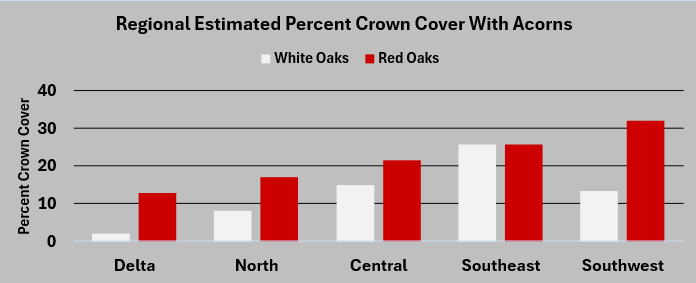
Overall, acorn production across Mississippi can be categorized as a good mast year. The white oak species generally had less acorn production than the red oak species, with some regions of the state reporting better acorn production than others.

 The statewide average PCA for white oaks was 12.90, while the statewide average PCA for red oaks was 21.79. In total, 1689 trees were sampled across the 35 survey areas, with 668 white oaks and 1021 red oaks surveyed.


Production by Region

  • Delta: Acorn production across the delta (7 survey sites) was poor for both red and white oaks. Survey sites varied, with many producing little to no acorns and others producing average crops. This area of the state was heavily affected by winter storm Fern in early 2026, which damaged many trees and likely greatly reduced mast production for the year. Production for white and red oaks was well below the statewide average. The impacts of winter storm Fern could likely affect acorn production for several years, as trees continue to heal from damaged and lost limbs.
  • North: Just like the delta, acorn production across the northern half of the state was poor (9 survey sites). The northern half of the state was heavily impacted by winter storm Fern and this likely harmed mast production. Areas more north-western in the state suffered greater impacts from Fern. Production for red and white oaks was slightly below the statewide average. Impacts from winter storm Fern could likely impact acorn production for several years.
  • Central: Acorn production for red and white oaks was above average for the central region (7 survey sites). Acorn production on many sites was average, sitting around  21% PCA. White oak acorn production was particularly impressive on some sites, with the 3rd highest white oak PCA in the state seen at Yockanookany WMA at 34%.
  • Southeast: The southeastern portion (6 survey sites) of the state likely has the best mast crop this year with both red and white oaks well above average and both sitting at roughly 25% PCA. Timely spring and summer rains likely helped many oak trees hold onto most of their mast crop compared to dryer years. The highest white oak PCA average for 2026 was recorded at Pascagoula WMA at 52.66%.
  • Southwest: The southwestern section (6 survey sites) of the state had the second-best mast crop of 2026. The red oak crop was particularly good, with this region of the state recording the highest average PCA for red oaks at 31.90%. Survey sites varied in acorn production, with some sites showing better white or red oak production, while others had above average for both groups.


Red Oak


White Oak

Hunter Outlook

What do the 2026 mast survey results mean for hunters? 

Hunters in the southern portion of the state may experience fewer deer sightings as acorns begin to fall, since both oak species groups are likely to have above-average acorn production. Deer will likely move less as they target areas of high oak abundance searching for acorns, but hunters can use this to their advantage by hunting near or over hardwood areas. Hunters in other areas, particularly the delta and north portion of the state, will have less of an acorn crop to deal with. Sightings will likely be better in fields and food plots, as these areas will be an even more important food source with fewer acorns on the ground. It is also important to remember that just because the average acorn crop is low, it does not mean that some areas or trees cannot produce a large crop. Finding these areas or trees, particularly in portions of the state with overall average or low acorn production, could yield fantastic results for hunters.