Written by: Chandler Strickland
Edits by: Pierce Young
Few decisions in deer management create more debate than deciding which bucks should be harvested. What makes a buck a true management deer isn't always obvious from the ground, and simply judging a deer by the size of his antlers can lead to poor management decisions.
Management-buck decisions work best when they are based on age, property-specific data, habitat conditions, and clearly defined goals—not simply an antler score or point count.
Manage the Herd, Not the Genetics
A common mistake is assuming that a smaller-antlered buck has "poor genetics" and needs to be removed. In free-ranging deer, antler development is influenced by genetics, but also by age, nutrition, health, and environmental conditions.
Research has shown that no level of intense buck harvest selection will influence population genetics. The main reason is because we can not select for antler genetics within does in the wild. Instead of trying to eliminate certain antler traits, focus on allowing quality bucks to reach older age classes while keeping the deer herd in balance with the available habitat.
If too many deer are competing for limited food, even good genetics won't overcome poor nutrition. This is where harvesting more management bucks could be useful.
Why Harvest Management Bucks?
Harvesting management bucks is not about trying to “breed out” undesirable genetics or removing every buck with small antlers. The primary purpose is to make better use of the deer herd and the habitat available on a property. Also known as weeding out the "standing crop".
When a property has a well-managed deer herd and adequate habitat, selectively harvesting bucks that meet established management criteria can help accomplish several objectives such as:
- Reduce Competition for Resources
- Remove Bucks That Won't Meet Your Definition of a Trophy
- Reduce Overcrowding and Help Prevent Some Higher-quality Bucks from Leaving
- Increase Opportunities for Hunters to Harvest Bucks
Ultimately, the purpose of harvesting management bucks is to support long-term management goals of the property.
Age Comes First
Choosing a management buck should start with one thing: age.
A buck's antlers can change dramatically as he gets older. A 1 and 2-year-old buck with a relatively small or average rack will develop into a much larger buck at 3, 4, and 5+ years-old.
That's why harvesting young bucks simply because they don't meet an arbitrary antler standard will be counterproductive. Give bucks time to mature, and evaluate them based on age and overall development, and compare that to the average bucks their age.
Body characteristics, behavior, and trail-camera history can all help estimate a buck's age.
Consider Where You Hunt
Age should always be considered alongside your location and habitat quality conditions.
Soil fertility, rainfall, agriculture, native browse, food-plot quality, and deer density all affect nutrition and antler development. A mature buck on poor soils with an overpopulated herd will often never be able to produce the same antler size as a mature buck living in a highly productive agricultural region or a property where the deer herd and habitat is properly managed.
For that reason, don't judge your deer by what a mature buck looks like somewhere else. Judge them against what mature bucks typically look like on your property and within your region.
Let Your Goals Set the Standard
There is no single management-buck rule that works on every property.
One landowner may be managing for the maximize number of mature bucks. Another may want to maintain a healthy deer herd while only allowing the highest quality bucks reach maturity.
The appropriate management-buck criteria will depend on those goals.
Choosing Which Management Bucks to Select:
Thirds Method
If a property has reached the point where management-buck harvest is appropriate, one useful approach is to use camera surveys and age-specific antler averages to identify bucks that consistently fall in the "bottom-third" of their age class, well below the average buck for their age.
This is much more meaningful than simply establishing a universal rule such as “shoot anything under 8-points.”
The buck's age gives the antler characteristics context.
For example: The average 3-year-old buck for the property has 8-points, above a 13-inch spread, and longer than a 16-inch main beam. While about 1/3rd of all the buck pictures of the poorest quality 3-year-old bucks have less-than 7-points, less-than an 11-inch spread, and less-than 14-inch main beams. That sets your management buck criteria for the 3-year-old age class for that year. Then you just repeat the same process for all other age classes for that year.
Why Be Careful With 2½-Year-Old Bucks?
The 2-year-old age class presents a potential issue.
At this age, it can be difficult to confidently distinguish a genuinely low-quality 2-year old buck buck from a very good high-quality 1-year-old buck.
This overlap between these two ages provides more "risk than reward".
If a hunter misidentifies a 2-year-old buck as a management deer, there is a greater chance of accidentally removing a buck that could have developed into one of the property's best mature bucks over time.
For that reason, it is recommended to avoid 2-year-old bucks when selecting management bucks.
For all other ages classes this issue does not exist. There is more "reward than risk" when choosing management bucks at 3, 4, and 5+ year-old. For example, if you see a buck you think is a "bottom third" 3-years-old, shoot him, and he's only a 2-year-old, he'll at best be an "average" buck, and not your all-star. The reason is that at this age, bucks have more predictability of what their full-potential may be at maturity.
Mature Bucks
Bucks generally reach physical and antler maturity at approximately 5-years-old. Meaning they have reached 98-100% of their antler quality potential.
These bucks have reached their peak antler performance and should be harvested regardless of antler size.
What About 1½-Year-Old Bucks?
This is where management-buck selection gets especially interesting and more complex.
A yearling spike can develop into a quality adult buck. But that doesn't mean every yearling spike must be protected. The question is whether that particular deer fits the management objectives for that property. The size of the spikes matter.
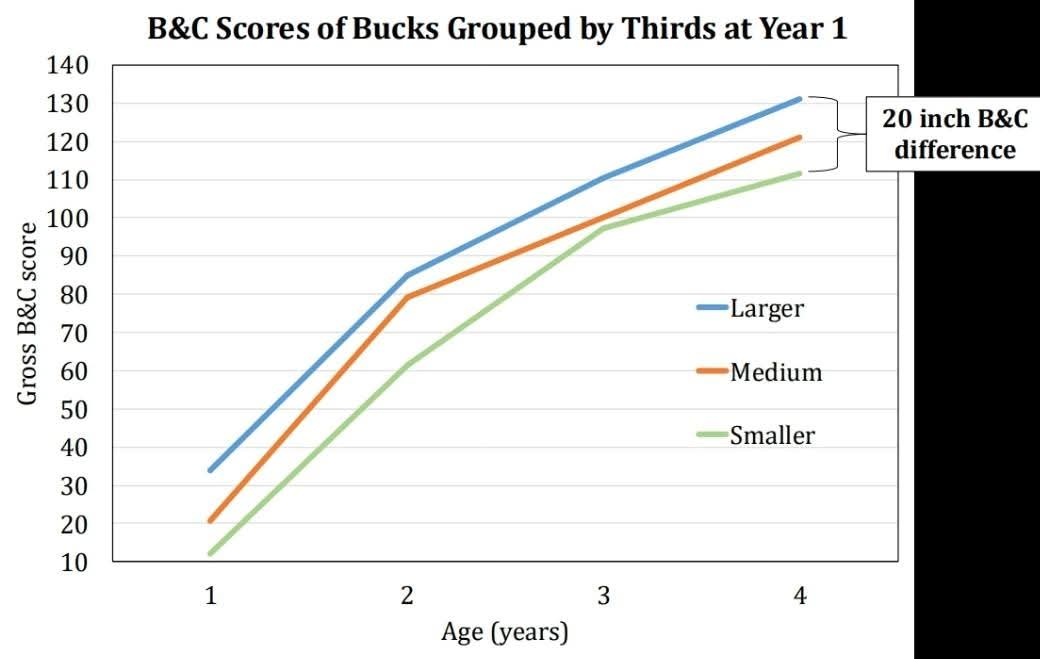
In many buck populations, the average 1-year-old buck will be a spike (no forked antlers). Research has shown that although yearling buck antlers are not a good predictor of genetic potential, it is a good clue to where that buck will rank on average among other bucks born in the same year when they reach maturity. This means the smallest spikes will on average be the smallest mature bucks when they get older, and not all spikes are created equal.
On properties with the appropriate management goals and sufficient information, targeting the lowest-quality 1-year-old bucks after dispersal can be a useful strategy.
Yearling bucks are often among the most visible and easiest bucks to identify. After the rut, many 1-year-old bucks have dispersed and established their own home ranges on to your property.
The advantage is that these deer have not yet spent several additional years consuming the property's resources and their removal can create additional space for the remaining deer.
These bucks are also relatively naive compared to older bucks, whereas bucks aging 3, 4, and 5+ years-old will become more weary and harder to hunt over time.
A practical example of a management criterion might be a yearling spike with antlers less than about 3 inches in length, provided that criterion is based on the "bottom third" for that specific property and management program. There are no other age groups to confuse with, making selection the easiest.
However, a property should establish its own criteria based on its habitat, deer herd, management objectives, and available data.
The Bottom Line
The goal is to make the harvest decisions that best fit the deer herd, habitat, and management objectives of your property.
Before implementing a management-buck harvest strategy, consider working with a qualified wildlife biologist who can help establish property-specific age and harvest criteria based on your habitat, deer herd, and management goals.
For more wildlife management information visit: