
Written by: Pierce Young
Few things are more frustrating than spending time and money establishing a food plot only to end up with a thin stand full of weeds. Many times the culprit is poor rainfall, excessive grazing pressure, or improper seedbed preparation. However, one of the most overlooked causes of poor food plot establishment is using the wrong seeding rate.
The problem often begins with a misunderstanding of what is actually inside a bag of seed.
Many food plot species, especially legumes such as clovers and alfalfa, are sold with coatings that contain inoculants, lime, fungicides, micronutrients, or other treatments designed to improve establishment. These coatings are beneficial, but they add weight to a bag. Likewise, not every seed in the bag is capable of germinating.
This is why successful food plot managers calculate seeding rates based on Pure Live Seed (PLS) rather than simply planting the number of pounds listed on the bag.
What Is Pure Live Seed?
Pure Live Seed (PLS) is the percentage of a seed lot that consists of viable seed capable of producing plants.
Two values found on every certified seed tag are needed to calculate PLS:
- Pure Seed Percentage – The percentage of the bag that is actually the desired crop seed.
- Germination Percentage – The percentage of those seeds expected to germinate under favorable conditions.
The formula is simple:
PLS (%) = Pure Seed (%) × Germination (%)
When calculating, convert percentages to decimals.
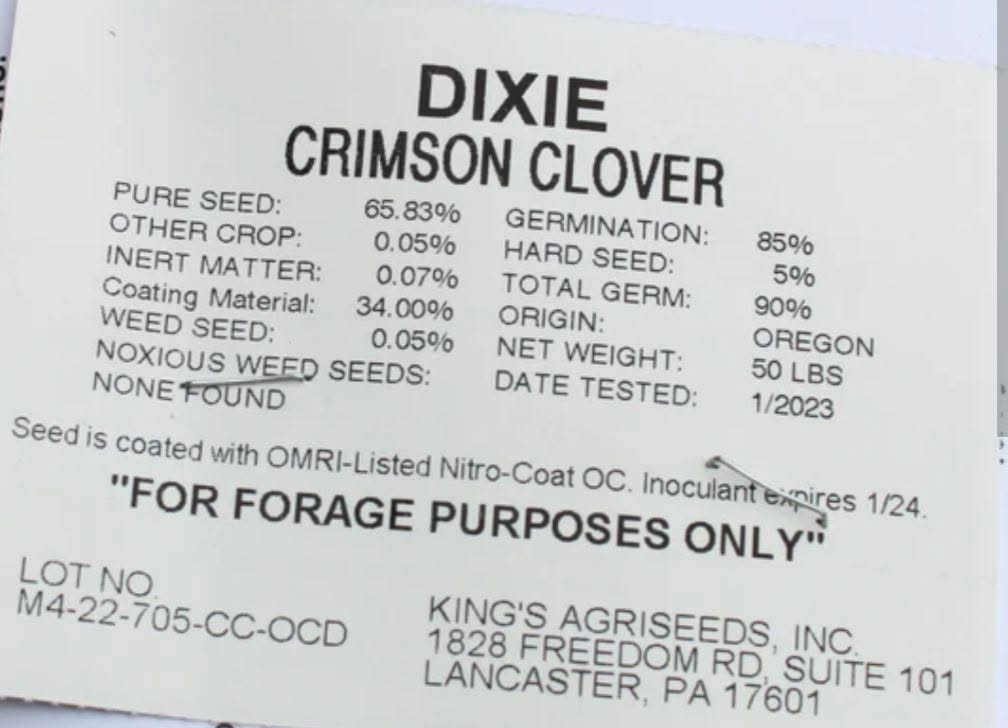
Example
Suppose a clover seed tag lists:
- Pure Seed = 65.83%
- Germination = 85%
PLS = 0.6583 × 0.85 = 0.56, or 56% Pure Live Seed
This means only 56% of the bag consists of live seed expected to germinate.
What Does That Mean in the Real World?
Let's assume you purchase a 50-pound bag of this clover seed.
Since the bag contains only 56% PLS:
50 lbs × 0.56 = 28 lbs of pure live seed
Although the bag weighs 50 pounds, only about 28 pounds are actually viable clover seed.
The remaining weight consists of coating material, inert matter, damaged seed, or seed that will not germinate.
Calculating the Correct Seeding Rate
Suppose the recommended seeding rate is:
15 pounds PLS per acre
Because your seed bag contains only 56% PLS, you cannot simply plant 15 pounds from the bag.
Instead, divide the recommended PLS rate by the PLS percentage:
15 ÷ 0.56 = 26.8
You would need approximately:
27 pounds of that product per acre
to achieve the recommended 15 pounds PLS per acre.
If you only planted 15 pounds from the bag, you would actually be applying:
15 × 0.56 = 8.4 pounds PLS per acre
In other words, you would be planting barely half the recommended amount of viable seed.
This is important because many seeding recommendations are expressed as Pure Live Seed rates, not product weight. The goal is to establish the proper number of plants per acre regardless of differences in seed quality, germination, or coating material.
A Note About Seeding Recommendations
Not all seeding recommendations are expressed the same way. Some wildlife biologists or consultants may provide recommendations based on typical commercial seed products rather than strict Pure Live Seed calculations. In these cases, the recommendation may already account for common germination rates and pure seed percentages found in the marketplace.
For example, a biologist recommending 15 pounds of clover per acre may be referring to 15 pounds of product from the bag because the recommendation was developed around commonly available coated seed. Another recommendation may specifically refer to 15 pounds of Pure Live Seed per acre, which would require adjusting the amount planted based on the seed tag.
For this reason, it is always a good idea to ask whether a recommended seeding rate is expressed as pounds of product per acre or pounds of Pure Live Seed per acre. Understanding how the recommendation was developed will help ensure you plant the intended amount and avoid either under-seeding or purchasing more seed than necessary.
A Simple Formula to Remember
Whenever you buy seed, remember these two calculations:
Step 1: Calculate PLS
PLS (%) = Pure Seed (%) × Germination (%)
Step 2: Calculate Seeding Rate
Recommended PLS Rate ÷ PLS (%) = Pounds of Product to Plant
Using these formulas ensures you are planting the amount of viable seed recommended by research rather than simply relying on bag weight.
The Bottom Line
Pure Live Seed is one of the simplest yet most important concepts in food plot establishment. A bag may weigh 50 pounds, but only a portion of that weight may be living seed capable of producing plants.
Failing to account for purity, germination, and seed coatings can result in under-seeded food plots, reduced forage production, and increased weed pressure.
Before planting your next food plot, take a few minutes to read the seed tag and calculate PLS. That small investment of time can make the difference between a thin stand struggling to compete with weeds and a dense, productive plot that provides high-quality forage for wildlife throughout the season. Doing so can help ensure your food plots reach their full potential while making the most of every dollar spent on seed.
For more wildlife management information, visit