Written by: Pierce Young
One of the most common questions landowners ask is, “What habitat practice gives me the biggest return on investment?”
The answer depends on objectives, but understanding the relative costs of different management practices helps prioritize where limited time and money are best spent.
In surveys conducted by wildlife agencies and conservation organizations, time and money consistently rank among the most common reasons landowners do not implement desired habitat improvements. Most landowners have more habitat needs than they have resources available to address them. As a result, understanding relative costs, scalability, and long-term habitat return is essential for making effective decisions.
Another key consideration is scale. A practice may produce excellent results on a few acres but become difficult to expand across an entire property. Other practices can be implemented across tens, hundreds, or even thousands of acres while maintaining relatively low per-acre investment requirements.
For example, food plots often represent only about 1–5% of a property’s total acreage, even on intensively managed lands. In contrast, practices such as timber harvest, timber stand improvement, and prescribed fire can influence the majority of a property’s acreage, fundamentally altering habitat conditions at a landscape scale.
Supplemental feeding also has important biological limitations. A portion of the deer population may never regularly use feeders, and even deer that do use them often do so inconsistently. As a result, a highly concentrated and expensive input may only be partially utilized by the herd despite continuous investment.
When viewed through the lens of cost efficiency, scale, and biological reach, some wildlife management practices consistently outperform others.
Commercial Timber Harvest
Commercial timber harvest is often the most cost-effective habitat management practice available because it frequently generates revenue rather than requiring a net investment.
When properly implemented, timber harvest increases sunlight reaching the forest floor, stimulating native forbs, vines, brambles, woody browse, and other high-value deer forage species. This response creates both nutritional resources and structural habitat diversity across harvested stands.
The most important advantage of timber harvest is scale. A single operation can influence large, contiguous portions of a property, producing landscape-level changes in forage availability, bedding cover, and early successional habitat.
Because harvests can return revenue while simultaneously improving habitat, commercial timber harvest is considered the baseline reference point for cost efficiency in habitat management.
Timber Stand Improvement (TSI)
Timber stand improvement (TSI) is often the next logical step when commercial harvest is not feasible or when additional habitat enhancement is needed in unharvested stands.
TSI includes practices such as hack-and-squirt, girdling, selective thinning, and targeted removal of undesirable stems to increase sunlight and reduce competition.
When evaluated strictly on forage production efficiency, contracted TSI generally falls around ~$0.02/lb of forage, while DIY TSI—where landowners provide their own labor and only invest in materials—can approach ~$0.01/lb of forage.
TSI improves both timber quality and wildlife habitat by reallocating site resources toward more desirable tree species and increasing understory production. Like timber harvest, it functions at a stand scale, meaning large portions of a property can be improved through strategic implementation over time.
Supplemental Feeding
Supplemental feeding is widely used in deer management but is among the least efficient methods of producing usable nutrition when evaluated at scale.
When expressed as cost per pound of forage delivered to deer, supplemental feeding is approximately ~$0.5/lb of forage, making it significantly more expensive than habitat-based alternatives.
In addition to cost efficiency concerns, supplemental feeding has biological limitations. A portion of the deer herd may not regularly use feeders, and even deer that do use them often exhibit inconsistent visitation patterns. As a result, much of the provided nutrition benefits only a subset of the population at any given time.
Unlike habitat management practices, supplemental feeding does not improve the long-term forage production capacity of the land.
Warm-Season and Winter Food Plots
Food plots are among the most productive tools for producing highly digestible forage in wildlife management systems.
Summer food plots can produce extremely high volumes of forage during peak growing conditions, while winter food plots provide critical cool-season nutrition when native forage quality declines.
When evaluated on a forage production basis, summer food plots typically average around ~$0.01/lb of forage, while winter food plots average approximately ~$0.05/lb of forage due to lower seasonal productivity and higher relative establishment cost per unit of forage produced.
Despite their productivity, food plots are generally constrained by scale. Even on intensively managed properties, they often represent only 1–5% of total acreage, limiting their influence on overall habitat conditions. Expansion beyond this level increases logistical complexity and management input requirements.
For most properties, food plots function best as a supplemental nutritional and hunting tool rather than the primary habitat driver.
Prescribed Fire
Prescribed fire is one of the most efficient and scalable habitat management tools available for improving forage production and habitat diversity.
When evaluated in terms of forage production efficiency, prescribed fire typically averages around ~$0.02/lb of forage.
Fire stimulates native plant communities by releasing sunlight and nutrients, encouraging the growth of forbs, legumes, brambles, and woody browse species that are highly valuable to deer and other wildlife. It also improves structural diversity and maintains early successional habitat conditions over time.
One of the most important advantages of prescribed fire is its scalability. Large portions of a property can be treated in a single application, allowing managers to influence habitat conditions across broad spatial scales at relatively low cost.
Cost Per Pound of Forage Comparison
When comparing wildlife management practices, cost per pound of forage provides a standardized measure of efficiency.
Cost Per Pound of Forage
Commercial timber harvest (often produces revenue rather than cost)
DIY TSI (~$0.01/lb)
Summer food plots (~$0.01/lb)
Prescribed fire (~$0.02/lb)
Contracted TSI (~$0.02/lb)
Winter food plots (~$0.05/lb)
Supplemental feeding (~$0.5/lb)
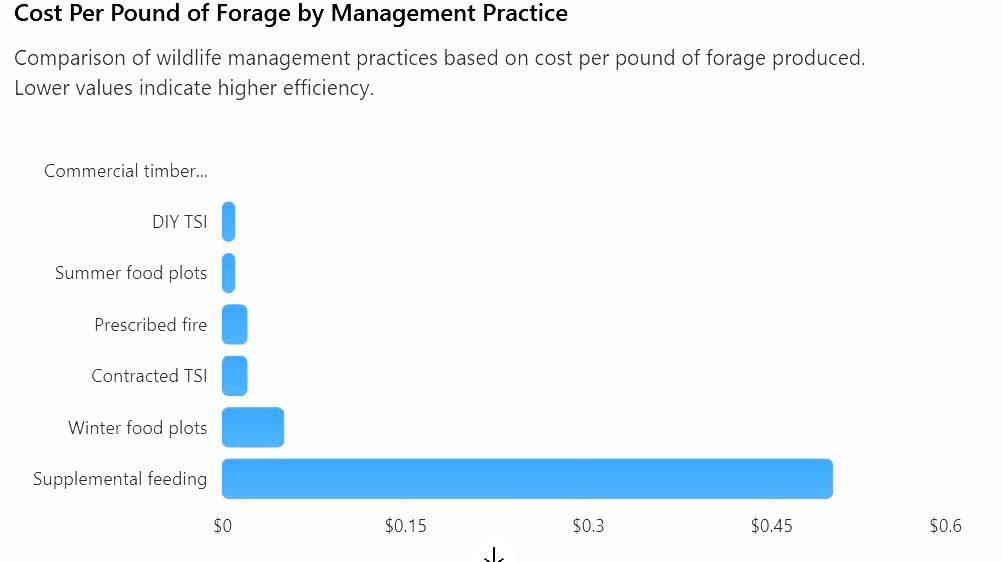
Commercial timber harvest remains unique in that it often generates revenue while simultaneously improving habitat, making it the benchmark for cost-effective management.
Several key patterns emerge:
- Habitat practices that operate at large spatial scales (timber harvest, TSI, prescribed fire) influence a far greater portion of a property than food plots or supplemental feeding.
- Food plots, while highly productive per acre, are typically limited to 1–5% of total property area, restricting landscape-level impact.
- Supplemental feeding is significantly less efficient due to both high cost per unit of nutrition and inconsistent herd utilization.
- DIY TSI and prescribed fire consistently rank among the most cost-efficient tools available when properly applied.
Putting It All Together
Comparing wildlife management practices through cost efficiency, scale, and biological effectiveness provides a clearer framework for prioritizing land management decisions.
Commercial timber harvest often provides the greatest overall return because it can generate revenue while improving habitat across large portions of a property. When harvest is not possible, timber stand improvement provides a similar pathway for increasing forage production and habitat quality.
Prescribed fire remains one of the most scalable and cost-efficient tools for maintaining productive habitat across entire landscapes. Food plots and supplemental feeding can play important roles in targeted situations but are generally most effective when used to complement broader habitat-based strategies rather than replace them.
Ultimately, the greatest limitation for most landowners is not a lack of knowledge, but constraints in time and resources. Understanding how different practices compare in efficiency and scale helps ensure those resources are directed toward the highest-return habitat investments.
In most cases, the most effective strategy is to focus on practices that increase sunlight and allow native plant communities to respond across large portions of the property, rather than concentrating inputs into small, high-cost areas.
For more wildlife management information, visit