
Written by: Kevin Owens
Edits by: Pierce Young
Perennial food plots are one of the most efficient long-term habitat investments available to landowners managing for white-tailed deer, wild turkey, rabbits, and pollinators. When properly established and maintained, they provide multi-year forage production with reduced soil disturbance, lower long-term costs, and improved ecosystem stability compared to annual plantings.
Unlike annual plots that require full replanting each year, perennial systems function as managed plant communities. Their success depends less on yearly planting and more on soil health, plant selection, grazing pressure, and timely maintenance.
Well-managed perennial plots provide:
- Reliable forage during stress periods (late-summer heat, late-winter cold)
- High-quality protein for antler growth and lactation
- Insect production critical for wild turkey poults
- Pollinator habitat
- Transitional forage between cool-season and warm-season annuals
Species Selection (Core Perennial Plants)
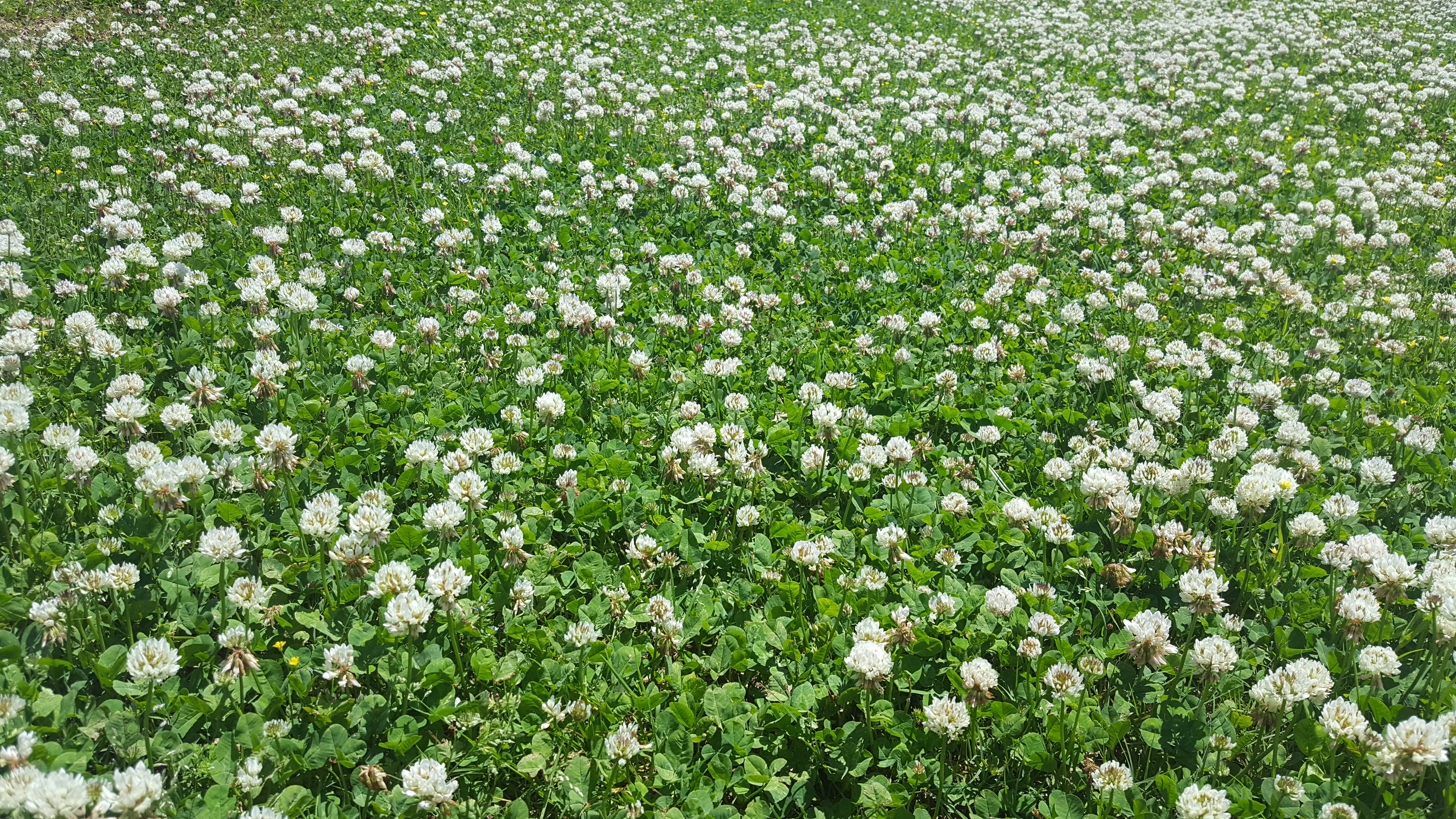
White Clover
White clover is the most dependable perennial food plot species across Mississippi.
Key traits
- High protein (20–25%)
- Excellent grazing tolerance
- Nitrogen-fixing legume
- Persistent under moderate pressure
Soil requirements
- pH: 6.0–7.0 (critical)
- Moderate to high fertility
- Good drainage preferred but adaptable
Varietal guidance
- Durana-type clovers → best for full sun, heat tolerance, drought resistance
- Ladino-types → higher yield, slightly better in wetter/looser soils, less drought tolerant
Red Clover
- Faster establishment than white clover
- Short-lived (2–3 years typical)
- Strong spring/summer production
- Higher drought tolerance than white clover
Best use
- Companion species to boost early forage
- Transitional “fill” species while white clover establishes
Soil requirements
- pH: 6.0–7.0 (critical)
- Moderate to high fertility
- Good drainage preferred
Chicory
- Deep taproot improves drought resilience
- Excellent summer productivity
- High mineral content and deer preference
Requirements
- pH: 5.5–7.0
- Full sun preferred
- Moderate fertility
Alfalfa (High-Input System)
- 18–25% protein
- Extremely high deer preference when maintained properly
- Highest forage yield potential of perennial legumes
Critical limitations
- Monthly pesticide spraying is often required in Southern regions.
- Requires pH 6.5–7.0
- Requires high potassium fertility
- Cannot tolerate poorly drained soils
Establishment Timing (Mississippi)
September – October
- Best root development
- Lowest weed pressure
- Highest survival rate
Soil Testing and Fertility
A soil test is non-negotiable in perennial systems.
Fertilizer
- P: medium to high
- K: high (especially alfalfa systems)
- N: minimal after establishment (legumes fix nitrogen)
Lime
- Must be applied 3–6 months before planting if possible
- pH below 6.0 severely limits clover performance
- Alfalfa requires near-neutral conditions for persistence
Seedbed Preparation (Establishment Driver)
Ideal sequence:
- Kill existing vegetation (glyphosate-based burndown)
- Wait 10–14 days for complete desiccation
- Light disking or no-till drilling
- Firm seedbed with cultipacker
Field test:
If your boot sinks more than ½ inch → seedbed is too soft
Firm seed-to-soil contact is more important than depth of tillage.
Seeding Methods and Depth
- Broadcast + cultipack (common)
- No-till drill (most reliable)
- Frost seeding (late winter clover reinforcement)
Depth guidelines
- Clover: 0–¼ inch
- Chicory: ¼–½ inch
- Alfalfa: ¼–½ inch
Deep planting is a leading cause of failure.
Pure Live Seed (PLS) and Seeding Rates
Pure Live Seed (PLS) is the actual percentage of a seed batch that is both viable (capable of germinating) and pure.
PLS = Purity % × Germination %
Typical rates (PLS basis)
- White clover: 4–6 lbs/acre
- Red clover: 6–10 lbs/acre
- Chicory: 2–4 lbs/acre
- Alfalfa: 12–20 lbs/acre
Example blend
- 4 lbs white clover
- 3 lbs red clover
- 2 lbs chicory
= ~9 lbs/acre total
Inoculation (Critical Step)
Legumes require Rhizobium bacteria for nitrogen fixation.
Best practice
- Use pre-inoculated seed when possible
- If coating manually:
- Use correct inoculant strain (clover vs alfalfa specific)
- Use a light sticking agent (water + sugar solution works; soda)
- Mix thoroughly for uniform coverage
- Keep out of direct sun
- Plant within 24 hours
Failure to inoculate = poor vigor + nitrogen deficiency symptoms.
Herbicide Management (Core to Long-term Success)
Perennial plots are managed plant communities, not “set-and-forget” plantings.
Pre-emergent herbicides
A chemical applied to the soil after planting to prevent weed seeds from germinating. The chemical is incorporated into the soil by rainfall or irrigation. Typically applied in the early Spring or Fall.
Most Common
- Imazethapyr (Pursuit) - A pre-emerge herbicide commonly used in legumes for control of broadleaf weeds, grasses, and sedges for an average of 6 months. Application rate is 4 oz per acre. It can also be applied as a post-emergent herbicide.
- S-metolachlor (Dual Magnum) - A pre-emerge herbicide commonly used in legumes for control of broadleaf weeds, grasses, and sedges for an average of 4 months. Application rate ranges from 0.5-1.5 pints per acre.
- Imazamox (Raptor) - A pre-emerge herbicide commonly used in legumes for control of broadleaf weeds and some annual grasses for an average of 2-4 weeks. Application rate ranges from 4-6 oz per acre. It can also be applied as a post-emergent herbicide on young weeds.
(Effect duration varies widely by soil, rainfall, and weed species pressure)
Post-emergent Herbicides
A chemical applied to weeds once they have already emerged from the soil and are actively growing; it needs to contact the foliage of the plant to be effective.
Most common:
- 2,4-DB (Butyrac) - A selective herbicide that targets broadleaf weeds without harming perennial legumes. It is effective against tough weeds like smartweed, thistles, pigweed, coffeeweed, and sicklepod. It is often used in combination with a surfactant to enhance effectiveness. Application rates range from 1-3 quarts per acre.
- Clethodim (Select) - A selective herbicide used to control grasses in legumes. It is often used in combination with a surfactant to enhance effectiveness. Application rates range from 8-10 ounces per acre for early/annual grass control, or 12-16 ounces per acre for late/perennial grass control.
- Sethoxydim (Poast) - Another selective herbicide commonly used to control grasses in legumes. Application rate is 2-3 pints per acre mixed with 2 pints of Crop Oil Concentrate.
- Bentazon (Basagran) - A selective herbicide commonly used to control sedges in legumes. Application rates range from 2-3 pints per acre.
- Halosulfuron-methyl (Sedgehammer) - A selective herbicide commonly used to control sedges in legumes. Application rates range from 0.75-1.5 oz per acre.
Core principle
Year 1 weed control determines 80% of long-term success.
Insect and Pest Management
In Mississippi perennial plots, insecticide use is typically limited and reactive.
Key pests in alfalfa systems
- Alfalfa weevil (late winter–spring) → primary concern
- Potato leafhopper (late spring–summer)
Occasional outbreak pests
- Armyworms (clover and alfalfa) in July-September
Common insecticides:
- lambda-cyhalothrin
- bifenthrin
- zeta-cypermethrin
- chlorantraniliprole
- spinosad
Mowing
Mowing is often overused, and misunderstood for perennial food plots.
Excessive mowing:
- Decreases forage production
- Stresses the plants
- Reduces deer usage
Guidelines
- Never mow perennial food plots more than once a year
- Never mow below 6 inches
- Never mow during dry hot conditions (increases stress)
Deer Pressure Management (Most Overlooked Factor)
Perennial plots fail more from grazing pressure than agronomy.
Overgrazing indicators
- Bare soil patches
- Reduction of leaf size
- Plant disappearance
- Weed increases
Seasonal Dynamics
Spring (March–May)
- Peak clover growth
- Highest protein availability
Summer (June–August)
- Chicory dominates production
- Clover stress under heat/drought and may go dormant
Fall (September–November)
- Regrowth period after rain and cooling
- Critical pre-rut nutrition window
Winter (December–February)
- Clover is primary green forage
- Best performance in 2nd and 3rd year stands
Longevity Expectations
- White clover: 3–5+ years
- Chicory: 3–4 years
- Red clover: 2–3 years
- Alfalfa: 3–5 years (high management dependency)
(Clovers may go dormant under stressful periods, but will resprout when conditions are more favorable)
Common Failures
- No soil test or ignored pH correction
- Planting too deep
- Poor seedbed firmness
- Weed competition in year 1
- Overgrazing during establishment
- Excess nitrogen application (drives weeds)
- Wrong species for site moisture/sun conditions
- Failure to inoculate legumes
Final Management Philosophy
Perennial food plots are not inputs-based systems—they are feedback systems.
Every decision (soil, seed, weed control, grazing pressure) compounds over time. The difference between a 5-year productive stand and a failed plot is almost always determined in:
Year 1 establishment and Year 2 management discipline.
When properly managed, perennial plots become the most stable, cost-efficient, and biologically productive component of a wildlife habitat system in Mississippi landscapes.
For more wildlife management and food plot information, visit