Written by: Chandler Strickland
Edits by: Pierce Young
Predation is a natural component of wildlife ecosystems and has shaped the behavior and survival strategies of white-tailed deer for thousands of years. However, excessive predation on fawns can significantly affect deer herd recruitment and population growth. When discussions arise about declining fawn survival, attention often focuses on predators themselves. While predators certainly play a role, it is often more accurate to view predation as the effect rather than the cause.
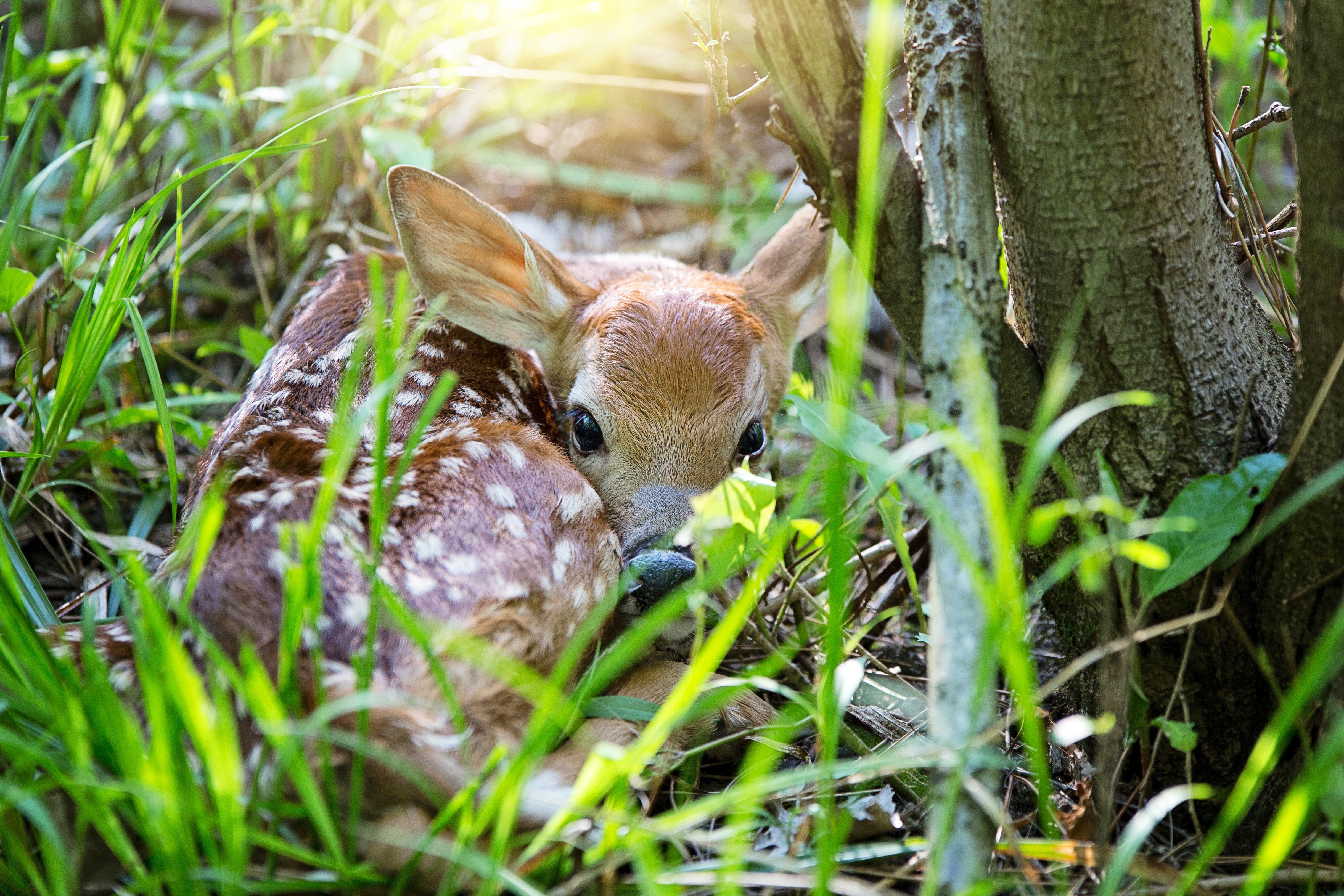
In many cases, the underlying cause of increased fawn predation is a lack of suitable habitat to hide. When adequate cover and quality forage are limited, predators can locate and capture fawns more efficiently. This is oftentimes regardless of predator numbers. Fawns are not able to fully utilize the traits they evolved to avoid predators, such as their spotted camouflage that mimics sunlight filtering through vegetation, reduced heart rate and movement when danger is nearby, and minimal scent production during their first weeks of life. Research has shown that large-scale removal of coyotes does not produce improvements in fawn recruitment when adequate fawning cover is absent. Habitat quality frequently has a greater influence on fawn survival than predator abundance alone. Therefore, improving habitat conditions is often the most effective long-term strategy for increasing fawn survival. By creating and maintaining habitat that provides security cover, adequate nutrition, and reduced predator efficiency, landowners can improve the odds that fawns survive their vulnerable first months of life.
Understanding Fawn Vulnerability
Newborn fawns rely heavily on concealment as their primary defense against predators. During their first few weeks of life, fawns spend much of their time hidden in vegetation while their mothers forage nearby for high-quality forage needed to support milk production and maintain their own body condition. Their spotted coats provide camouflage, they produce very little scent, and they instinctively remain motionless when danger approaches. These adaptations are remarkably effective under suitable habitat conditions.
The key to improving fawn survival is ensuring that adequate concealment habitat exists across the landscape during the fawning season.
Creating Quality Fawning Cover
Dense vegetation is one of the most effective tools for reducing fawn predation. Ideal fawning cover provides visual obstruction, limits predator movement, and creates a complex environment that makes it difficult for predators to detect hidden fawns.
The best fawning cover often consists of diverse understory plant communities dominated by native grasses, forbs, vines, shrubs, and young woody vegetation.
Research has demonstrated that fawns are often born in areas containing greater vegetation density and understory cover than what is available across the surrounding landscape. Does actively seek locations that maximize concealment for their offspring. When these cover types are scarce, multiple does may be forced to use the same limited areas, increasing predator search efficiency and reducing the effectiveness of a fawn's natural defenses.
Promoting Early Successional Habitat
One of the most effective ways to improve fawn survival is by promoting early successional plant communities across the property that consist of young, rapidly growing vegetation. These habitats provide exceptional concealment cover while simultaneously producing high-quality forage for nursing does during the stressful summer months.
The dense structure created by native grasses, broadleaf plants, shrubs, and regenerating woody vegetation provides ideal hiding cover for fawns while improving overall habitat quality for numerous wildlife species.
Landowners can encourage early successional plant communities through several management practices, including:
• Selective timber harvests
• Forest stand improvement practices
• Removal of non-native grasses in fields
These methods allow more sunlight to reach the ground and stimulate the growth of native vegetation. Once an early-successional plant community is established, it can be maintained and periodically reset through practices such as:
• Prescribed burning in forests or fields
• Disking and soil disturbance in native fields
These management activities stimulate plant growth and keep the vegetation from growing out of a beneficial stage for hiding fawns..
Increasing Habitat Diversity
Habitat diversity plays a critical role in reducing predator efficiency.
Large monocultures of uniform vegetation conditions often allow predators to move through the landscape more efficiently while searching for prey. In contrast, diverse habitat conditions create a complex environment that makes predator movements less predictable and less effective.
A heterogeneous landscape composed of multiple vegetation types, containing a mixture of forest stands, early successional habitats, native grass communities, shrub cover, and varying vegetation heights creates numerous hiding opportunities for fawns. This diversity prevents predators from systematically searching large areas and increases the likelihood that fawns remain undetected.
Research has consistently shown that landscapes containing abundant edge, structural diversity, and multiple cover types generally support better fawn survival than landscapes dominated by a single vegetation type.
Improving Doe Nutrition
Fawn survival begins long before birth. Research has shown that even in the absence of predators, fawn survival can remain low when nutritional limitations reduce fawn health, birth weights, and maternal condition.
The nutritional condition of does during pregnancy and lactation directly influences fawn health, birth weights, milk production, and overall survival potential. Does that have access to abundant, high-quality forage are more likely to produce healthy fawns capable of growing quickly and avoiding predators.
Many of the same habitat management practices that create fawning cover also improve nutrition.
By managing habitat to provide quality forage throughout spring and summer, landowners can improve both concealment and nutritional resources simultaneously in the same locations.
Reducing Predator Efficiency
Habitat management does not eliminate predators. However, habitat management can reduce predator efficiency by making it more difficult for predators to locate fawns. When predator management is combined with high-quality fawning habitat, the likelihood of predators encountering vulnerable fawns may be further reduced.
Dense vegetation limits visibility, increases search time, and reduces travel efficiency for predators moving through the landscape. Rather than concentrating fawns into a few isolated patches of cover, quality habitat spreads suitable fawning areas across the property. This dispersal effect decreases the probability that predators will encounter fawns during routine movements.
In essence, good habitat shifts the advantage back toward the fawn's natural defense strategy—remaining hidden and undetected.
Timing Habitat Work Carefully
Even beneficial habitat management practices can negatively impact fawn survival if conducted at the wrong time.
Heavy equipment, mowing, prescribed fire, timber operations, and other disturbances can expose hidden fawns to predators or directly increase mortality during the fawning season if management is not planned accordingly or conducted at the proper scale. Whenever possible, major habitat management activities should be scheduled outside peak fawning periods, in areas unlikely to impact fawns, or at a scale that minimizes disturbance to potential fawning cover.
In Mississippi, landowners should carefully consider habitat disturbances from mid-June through mid-August, when most fawns are being born and spending their first weeks concealed in vegetation. Once a fawn reaches approximately 8 weeks of age, it begins spending more time following its mother while foraging and less time relying on concealment as its primary defense.
By timing management activities appropriately, landowners can avoid unintentionally disrupting critical fawning habitat during the most sensitive period of the year.
Looking Beyond Predator Control
Predator removal can provide short-term improvements in fawn survival under good habitat cover conditions. However, predator populations often rebound, and removal efforts typically require substantial time, labor, and expense to maintain.
For this reason, habitat management should be viewed as the foundation of any long-term strategy aimed at improving fawn recruitment, and predator removal used for additional gains.
Conclusion
Habitat management is one of the most effective and sustainable methods for reducing fawn predation. By creating dense fawning cover, promoting early successional vegetation, enhancing habitat diversity, improving doe nutrition, and reducing predator efficiency, landowners can significantly improve fawn survival across their property.
Predation will always remain a natural part of the landscape, and it can never be completely eliminated. However, strategic habitat management can shift the balance in favor of fawns by providing the cover and resources they need to survive. In many cases, the question is not whether predators are present, but whether the habitat provides fawns with a realistic opportunity to avoid them.
When quality habitat is abundant, deer have evolved the tools necessary to coexist with predators. The role of wildlife management is to ensure those habitat conditions exist.
For more wildlife management information visit